

Oriient FAQs


Three questions come up in almost every first meeting: does it need hardware, how accurate is it, and does it watch people? The answers: no, about 3 ft (1 m), and no. The full list of 55 is below.
Have more questions? Contact us and we’ll get back to you as soon as we can.
The basics
What is Oriient?
Oriient makes the inside of a store knowable in real time, using the smartphones people already carry. It gives apps and store systems an indoor location accurate to about 3 ft (1 m). Many people call it indoor GPS. It does more than show a blue dot. It tells your systems where products, people, and tasks are on the floor.
How does it work without beacons or hardware?
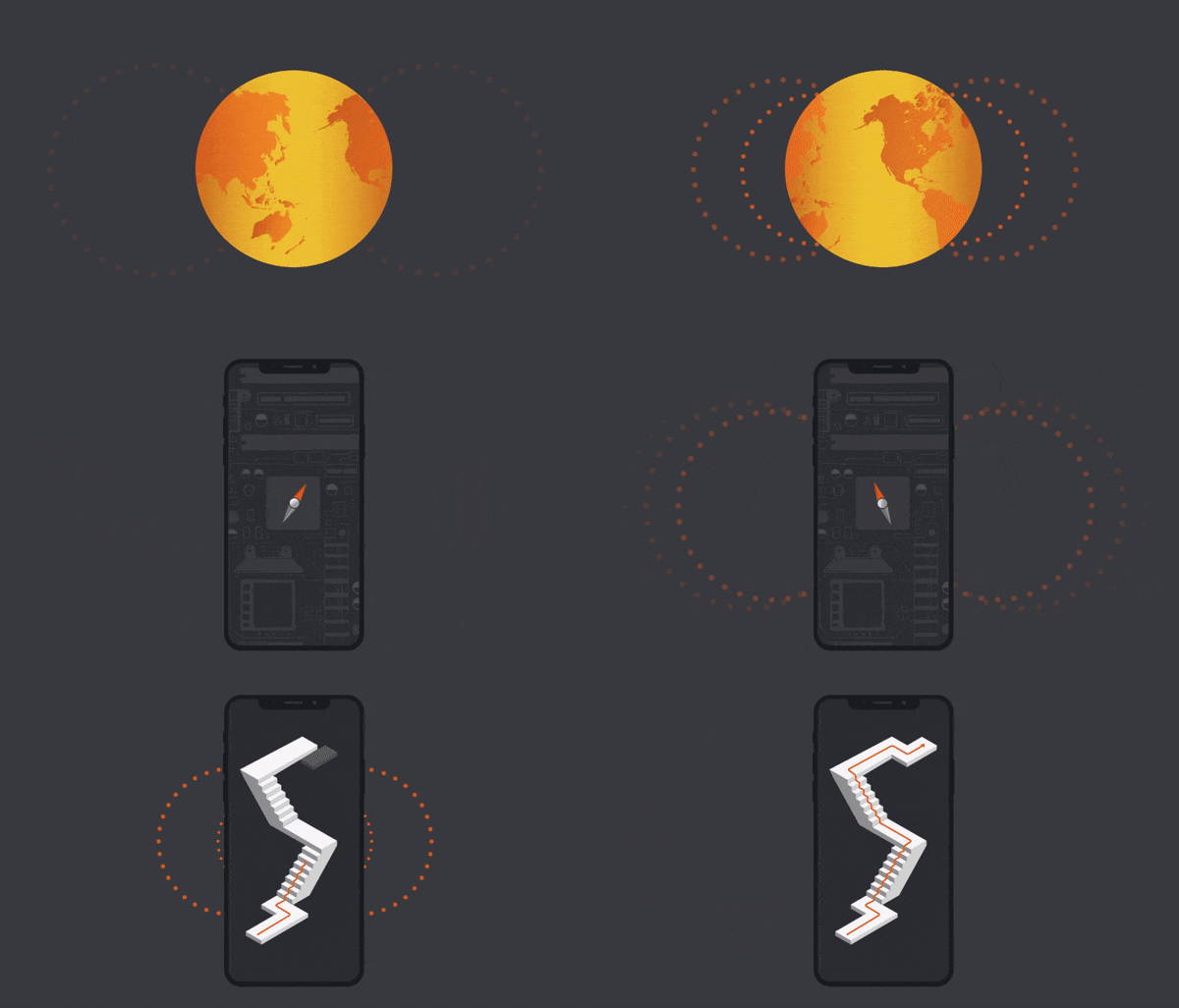
Every building bends the earth’s magnetic field in its own pattern. Oriient maps that pattern once. Then the sensors already built into a phone match what they read against the map to find its position. There is nothing to mount on walls or ceilings.
Does Oriient really use the earth’s magnetic field?
Yes. The earth’s magnetic field already runs through every building, and every building bends it in its own pattern. Oriient reads that pattern with the sensors built into the phone. The signal is already there, so there is nothing to install.
How accurate is it?
About 3 ft (1 m), on standard iOS and Android phones. We prove it in your store before rollout.
Which smartphones does Oriient support?
Every iPhone and practically all Android phones. The exception is very low-end, older models.
Does the phone have to be held upright?
No. Oriient works in any holding position. Carry the phone in your hand, rest it on a cart, or leave it in a pocket. Watch the live demo to see it in real time.
Does Oriient work with limited or no internet?
Yes. Oriient runs without 3G/4G or Wi-Fi, including in airplane mode. Read how offline support works.
Deployment and scale
How long does it take to deploy?
Initial mapping of a typical retail store takes about one day. You integrate one SDK once and replicate it across locations using the apps and systems you already run. We have demonstrated rollouts of 300+ stores per week. There is no positioning hardware to buy, install, or maintain, so no hardware CapEx.
How long does it take to map a location?
One day for a typical store. Larger sites take longer. Timing varies based on the size and complexity of the environment.
How much IT work is required?
Oriient requires integration into the app, workflow, or system tied to the use case. The exact effort depends on the existing environment and integration scope, but Oriient does not require a dedicated positioning-hardware rollout.
Can one integration support multiple locations?
Yes. One integration runs in every location on the same app. This is a key part of Oriient’s enterprise-scale deployment model.
What happens before go-live?
Oriient works with customer teams to validate the integration and positioning performance in the live environment before broader deployment. Depending on the use case, this can include technical review, field testing, and validation of relevant location data.
What support and SLAs does Oriient provide?
Every deployment includes integration support from our team, from SDK setup through field testing and go-live. After launch, you get ongoing technical support and regular check-ins. Service levels, including response times and performance targets, are defined per customer in the agreement. Contact us to discuss what your deployment needs.
What happens when a building or layout changes?
Oriient’s map updates itself. Our system refreshes the map every day from real user sessions, so small changes are picked up automatically. For larger changes, such as a renovation or a new floor plan, our team re-maps the affected area and updates the map, so positioning stays accurate.
Read more: Deployment and integration
Software-only versus hardware
Does Oriient require beacons, Wi-Fi positioning, or dedicated hardware?
No. Oriient uses the earth’s magnetic field and sensors already built into standard smartphones to determine indoor position without dedicated positioning hardware.
Does software-only mean less accurate?
No. Oriient delivers approximately 3 ft. / 1 m accuracy without dedicated positioning hardware.
How is Oriient different from beacon-based indoor positioning?
Beacon-based systems rely on dedicated devices installed throughout the environment. Oriient uses the building’s magnetic signature and sensors already built into standard smartphones, so it doesn’t require a dedicated beacon network.
How is Oriient different from Wi-Fi positioning?
Wi-Fi positioning derives location from network infrastructure and configuration. Oriient’s core positioning technology does not depend on Wi-Fi for location; it uses the earth’s magnetic field and smartphone sensors.
How does Oriient compare with camera-based positioning?
Camera-based systems use visual infrastructure and computer vision to determine location. Oriient determines position using smartphone sensors and the building’s magnetic signature, without requiring cameras for positioning.
Why choose Oriient over Wi-Fi and Bluetooth solutions?
Systems built on beacons and routers depend on hardware that someone has to buy, install, and maintain in every building. Oriient is software-only. It uses the sensors already in the phone and the building’s magnetic signature, so a new location is a map, not an installation. Compare indoor positioning technologies.
Why does software-only matter at enterprise scale?
Because every additional location doesn’t require a new dedicated positioning-hardware rollout. After the first store, each new location is a map, not an installation.
SDK and integration
Does Oriient offer an SDK?
Yes. Oriient provides SDKs for iOS and Android, supported by APIs and technical resources for implementation.
How complex is the SDK integration?
Onboarding includes documentation, sample apps, code review, and support through go-live.
What systems can Oriient integrate with?
Oriient can bring real-time indoor location into existing apps and operational workflows through its SDKs and APIs. The exact integration depends on the customer’s systems and use case.
How does Oriient connect with existing apps and systems?
Oriient provides SDKs and APIs that allow real-time indoor location context to be incorporated into existing apps, workflows, and operational systems.
Do shoppers need to download another app?
No. Oriient is an SDK that runs inside the retailer’s existing app. Shoppers keep using the app they already have, and the app gets one more reason to be opened in the store.
Does Oriient provide analytics?
Yes. Oriient’s dashboard provides visibility into indoor location activity, including positioning sessions, usage trends, and activity across locations, helping teams measure adoption and understand how the technology is being used.
Read more: Developer and technical resources
Results and ROI
Where is it used, and what results do customers see?
Oriient is deployed across over 6,700 locations worldwide, covering 960M sq. ft. In comparable Oriient deployments, customers have seen 3–5% basket-size uplift, 40% picking-time improvement, and 3× nearby-deal conversion (source: Oriient customer performance data).
What ROI does Oriient deliver?
In comparable Oriient deployments, customers have seen 3–5% basket-size uplift, 40% picking-time improvement, and 3× nearby-deal conversion (source: Oriient customer performance data). The value comes from three places: products shoppers can find instead of skip, proximity promotions that grow the basket, and less labor spent searching. See the ROI breakdown.
Retail: contextual marketing
How does Oriient enable location-based marketing inside a retailer’s existing app?
Oriient’s SDK adds real-time indoor location context to existing retail apps, enabling location-aware offers, messages, and experiences.
What types of personalized offers and messages can retailers deliver?
Nearby deals, aisle-specific promotions, location-triggered reminders, navigation to offers, and interactive in-store experiences.
Does the shopper need to have the app open?
No. It is strictly opt-in, and the user needs to give permission, but the app can run in the background.
How does Oriient integrate with existing marketing and loyalty platforms?
Oriient provides indoor location context through its SDK. Specific marketing and loyalty integrations depend on the retailer’s systems.
How does Oriient protect shopper privacy?
Location-based experiences are opt-in. Shoppers control location permissions through their own devices.
How can retailers measure campaign performance?
Real-time indoor location context can help connect campaign engagement with relevant store locations. Measurement and attribution depend on the implementation.
Read more: Contextual marketing
Retail: product locations (PLAI)
How does Oriient’s PLAI determine where products are located?
PLAI geo-tags existing barcode scans with Oriient’s indoor positioning to learn where products are found and update location information over time.
How accurate is PLAI, and how often are locations updated?
Scanned products can be located to approximately 3 feet (1 meter). PLAI refines product-location information as new scans occur.
What happens when products move or appear in multiple locations?
PLAI analyzes scanning patterns to identify product movement, secondary displays, and multiple locations.
Does PLAI require additional hardware or scanning?
No dedicated positioning hardware or additional scanning routine is required. PLAI uses activity already happening in the store.
How is PLAI different from traditional inventory or planogram systems?
Inventory systems tell you what’s available. Planograms show where products should be. PLAI learns where products actually are.
How does PLAI integrate with existing retailer systems?
PLAI works with existing scanning workflows and can use current planogram data as a starting point or learn product locations from scratch.
Read more: Inventory intelligence (PLAI)
Healthcare
Does Oriient require beacons or dedicated positioning hardware?
No, Oriient’s core positioning technology uses the earth’s magnetic field and sensors already built into standard smartphones, so it doesn’t require dedicated in-building positioning hardware.
Can Oriient work across multiple floors and complex hospital campuses?
Yes, Oriient delivers real-time indoor positioning across mapped floors and buildings, including multi-building hospital campuses.
Can Oriient support patient and visitor wayfinding?
Yes, Oriient gives patients and visitors real-time, turn-by-turn guidance through complex facilities instead of relying only on signage or static maps.
What about medical equipment?
Oriient can provide location context that supports equipment visibility and related workflows. The exact approach depends on the equipment, devices, integration requirements, and use case.
How does Oriient integrate with existing hospital systems or apps?
Oriient provides SDKs and APIs that can be integrated into existing digital experiences and workflows. The exact integration depends on the hospital’s systems and use case.
How should a hospital get started?
Start with one measurable workflow in one environment. Define the friction, establish the KPI, validate the positioning technology, and measure whether adding real-time indoor location context changes the outcome.
Privacy and data
Does Oriient track or watch people?
No. It is opt-in. The phone knows where it is, and nobody is watched. Knowing what is happening inside a store does not require watching the people inside it.
Is Oriient compliant with privacy regulations?
Yes. Our solution is completely GDPR and CCPA compliant.
What kind of data does Oriient collect?
Oriient only collects the minimum amount of information necessary for our technology to determine the precise location of the user, mainly the phone’s sensor reading. While this is not considered personally identifiable information (PII) on its own, we make sure it is never linked to any other data —no name, email address, IP address, or any other sensitive information associated with the user.
However, since Oriient is an SDK embedded in our customer’s hosting app, they may choose to connect the location data to the individual user’s profile. But in order to do this, the hosting app must disclose this in the user service agreement.
By anonymizing the user’s data, only the app owner (that was granted permission) can tie the location of the phone to the identity of the user, Oriient will never know who the user is.
Where is this data stored? Who has access to it?
Oriient stores all data on a secure cloud server with the highest security and encryption standards. We never share data with 3rd parties without the explicit consent of our customers and app developers.
Should the user remove the app from their device, Oriient stops using their (randomly generated) user ID and any associated data. If the user re-installs the app, Oriient generates a completely new user ID.
What permissions does Oriient require to run?
Allowing the app to use your location “While Using” or “Only This Time” is sufficient to use Oriient.
While selecting “Always Allow” can speed up pinpointing your location once in the space, it’s not necessary.
How can the end-user know their indoor location is being tracked?
For full transparency, we notify the operating system of the phone to signal that the location is being tracked while the service is running if it’s in the background, and it may show up a banner throughout the visit.
Source: TechCrunch and Twitter.
Can the user disable the indoor location service?
The service won’t start running until it gets explicit permission from the user, without it the service will be denied.
Users can update or decline location permissions at any time.
Advanced users also have the option to go into their device settings for location tracking and select “approximate” instead of “accurate location,” which won’t allow the service to run.
Are you applying any other protections to make sure indoor location is used only when needed?
We only start the service if the phone is in/around the buildings related to the app that were mapped by Oriient for the purpose of indoor navigation. If the user leaves the specific geofenced area of that building, the service stops tracking their location and won’t resume until they re-enter such an area.
For privacy questions, contact sales@oriient.me. Read the full privacy FAQ

Think you know your stores? Prove it.


Stay ahead of what’s changing indoors.
Get Oriient research, perspectives, and practical ideas on the future of indoor location.