

HEALTHCARE
Hospitals shouldn’t have to run on signs, searching, and memory.
In a hospital, every minute matters. Wrong turns, wasted searches, and guesswork can delay care and pull staff away from patients. Oriient brings real-time indoor location context without dedicated hardware.
When people don’t know where, everything takes longer.
A hospital can be one of the most complex environments people have to navigate, often when they’re already under stress or time pressure. Patients and visitors miss turns. Staff stop to give directions. Teams lose time searching for equipment or moving between departments. Workflows depend on signage, static maps, calls, and institutional knowledge.
The problem isn’t that hospitals lack maps or systems.
It’s that those systems often lack real-time indoor location context about where people, work, and resources are inside the building.
Where missing context shows up

Patient & visitor navigation
Guide patients and visitors to appointments, departments, and services with fewer wrong turns and less reliance on staff directions.

Equipment visibility
Less time spent hunting for medical equipment by bringing more location context into workflows.

Staff & workflow context
Route tasks and alerts to where work needs to happen, reducing unnecessary movement and guesswork.
Real-time indoor location context without turning the hospital into an infrastructure project.
Oriient uses the earth’s magnetic field and sensors already built into standard smartphones to deliver accurate indoor location.
That means hospitals can bring location context into apps and workflows without installing dedicated positioning hardware throughout the facility.

Software-only indoor location
No dedicated positioning infrastructure to install across hallways, floors, or departments.

Accurate indoor positioning
Help users understand where they are and how to get where they need to go within 1 meter of accuracy.

Works with standard smartphones
Bring indoor location context into devices people and teams already use.

Built for complex environments
Works across multiple-floor buildings and campuses.
One location layer. More than one hospital workflow.
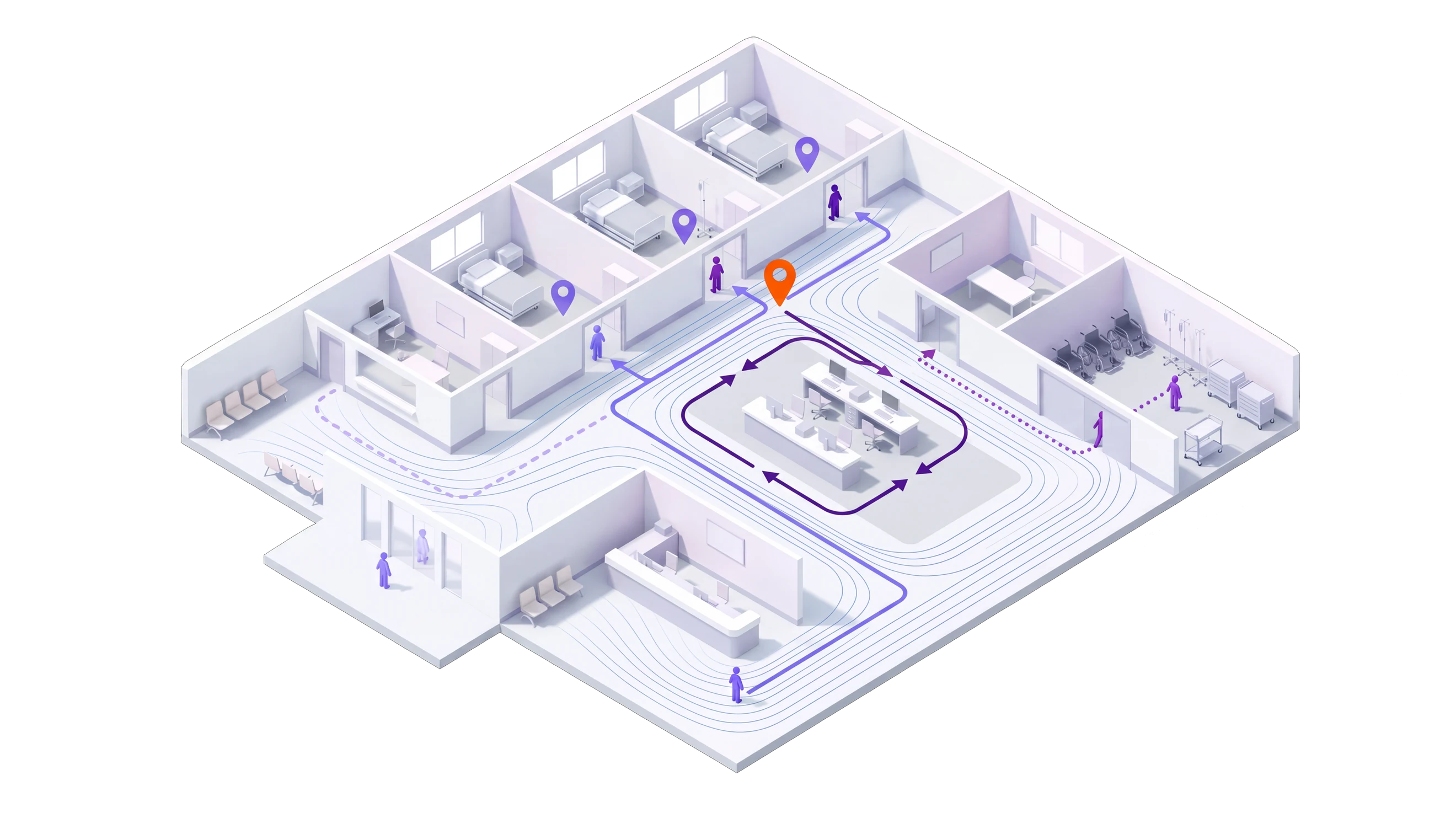


- Patient journeyEntrance → registration → department → exam room
- Visitor wayfindingParking / lobby → destination → exit
- Staff workflowTask assigned → nearest destination / department → next action
- Equipment visibilityLocation context → staff need → faster retrieval
The friction is measurable.
~30 minutes per week
Hospital staff lose critical time weekly helping others find their way, according to a 2025 U.S. survey.
Source: PubMedEquipment & supplies
The most frequently reported source of operational friction for frontline nurses.
Source: PMC PubMed Central
Start with one workflow. Prove it in a real facility.
Healthcare environments are complex. The fastest way to understand the value of indoor location context is to start with a defined problem, test it in a real environment, and measure what changes.
Talk to us about a healthcare pilotWHAT A PILOT ANSWERS
 Can patients and visitors reach destinations with fewer wrong turns or staff interventions?
- Can teams reduce time spent searching for mobile equipment?
- Can location context improve how tasks, alerts, or staff workflows are routed?
- Can the technology work accurately without adding a dedicated positioning infrastructure?
Frequently Asked Questions
No, Oriient’s core positioning technology uses the earth’s magnetic field and sensors already built into standard smartphones, so it doesn’t require dedicated in-building positioning hardware.

Your hospital runs on knowing what needs to happen. Oriient adds where.
Fewer wrong turns. Less time hunting for equipment. No dedicated positioning hardware in the hallways.